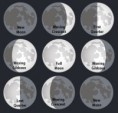
Phases
While the moon orbits Earth, a viewer on Earth will be able to observe the moon seems to alter shape. It looks to change from a crescent to a circle and reverse again. The form seems dissimilar from one day to the next because the viewers observe vary sections of the moon's sunlit surface as the moon revolves around Earth. The dissimilar looks are recognized as the phases of the moon. The moon moves throughout a total cycle of phases in a syndic month. The moon has four phases: (1) new moon, (2) first quarter, (3) full moon, and (4) last quarter. While the moon is between the sun and Earth, its sunlit section is moved aside from Earth. Astronomers named this dark phase a new moon. The following night afterwards a new moon, a thinly crescent of light up appears along the moon's eastern border. The left over part of the moon that turns to Earth is undimmed viewable because of earthshine, sunlight reflected from Earth to the moon. Every night, a viewer on Earth can observe a lot of the sunlit portion as the terminator, the line between sunlight and dark, shift westward. Following about seven days, the viewer will able to view half a full moon, usually called a half moon. This phase is identified as the first quarter because it takes place one quarter of the way throughout the synodic month. Approximately seven days afterward, the moon is on the area of Earth opposite the sun. The whole sunlit portion of the moon is now observable. This phase is called a full moon. Roughly seven days following a full moon, the viewers once more view a half moon. This phase is the last quarter, or third quarter. Afterward one more seven days, the moon is between Earth and the sun, leading to a new moon occurrence. While the moon alter from new moon to full moon, making it change to be viewable, it known to be waxing. When it alters from full moon to new moon, and fewer of will be able to be viewed, it is waning. As the moon looks little than a half moon, it is named crescent. While it appears bigger than a half moon, except it is not still a full moon, it is named gibbous.
Photos