Eclipses
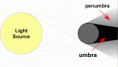
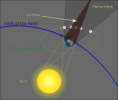
There are two shadows that are cast off by the moon and earth during eclipses. The dark shadow cast of by the moon and earth is called umbra and the light shadow is called penumbra an eclipse occurs as Earth, the sun, and the moons are in a direct line, or almost. A lunar eclipse happens while Earth becomes straight -- or nearly straight between the sun and the moon, and Earth's shade off side lays on the moon. A lunar eclipse will be able to take place on a full moon only. Although a full moon happens all month, a lunar eclipse happens fewer for the fact that the angle in between the plane of earth's orbit and the plane of moon's orbit. Full moon is mostly higher or below earth's umbra, and no eclipse happens. If an eclipse happened to occur, the moon mostly remains viewable, except it has a dusty red or coppery color. This is an outcome because earth’s atmosphere deflects some sunlight’s commonly larger red wavelengths-into the umbra. There are two types of lunar eclipses, total lunar and partial lunar eclipses. Total lunar eclipses take place when the moon is all in between earth's umbra. a partial eclipses take place while a portion of the moon is in earth’s umbra normally, a minimum of one total lunar eclipse take place every year. In a perfect weather it is viewable from the entire nighttime a portion of earth. When the moon travels throughout the center of the umbra, a total lunar eclipse might last as long a s two hours.
A solar eclipse happens as the moon gets straight between the sun and Earth, and the moon's shade off on Earth. A solar eclipse can only happen on a new moon. The whole shadow of the umbra and penumbra is approximately 7000 kilometers wide, larger than the continental united states. Though the diameter of the umbra, which the affect of the eclipses are mainly dramatic, but has not pass 270 kilometers only as large compared to the state of Indiana. As a result of the plane of the moon's orbit, the moon’s shade off mostly falls above or under earth. Just like a lunar eclipses, a solar eclipse does not take place every month. Though a minimum of a solar eclipses take place every year, a designated area experiences a total solar eclipses only once every three or four centuries. This occurrence is because of the small size of the moon umbra. The moon's revolution allows the narrow shadow, named the eclipses path, run across earth at more than 1500 kilometer per hour. The eclipses path way might be thousands of kilometers long, but at any one location a total solar eclipses will be able to last at most only 7.5 minutes.Photos